
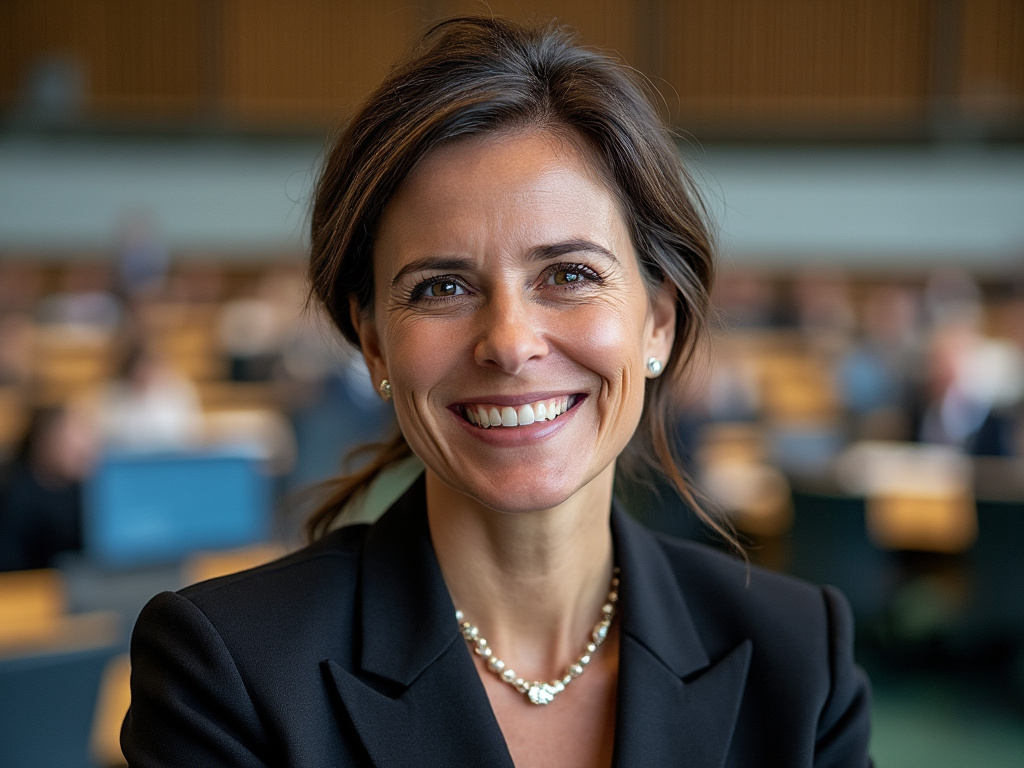
Annalena Baerbock Nominated for President of the UN General Assembly
Germany's Foreign Minister set to assume a pivotal role at the United Nations in September 2025.
Annalena Baerbock, Germany's Foreign Minister and a prominent member of the Green Party, is set to be nominated for the position of President of the United Nations General Assembly for the session spanning 2025 to 2026. Government sources indicate that a cabinet decision to endorse her candidacy is currently being processed, with an official vote expected at the UN General Assembly in early June 2025.
If elected, Baerbock will assume her one-year role in September 2025 and will subsequently resign from her position as a member of the German Bundestag.
The role of UN General Assembly President is predominantly ceremonial, involving the presiding over plenary sessions and ensuring adherence to procedural rules.
However, the president also has the potential to initiate thematic debates and play a mediating role in consultations and negotiations on significant UN issues.
Baerbock's election is anticipated to be a formality according to internal discussions within the UN. She first gained political prominence in 2021 when she led the Green Party as Germany's first female chancellor candidate in the federal elections.
Following the coalition government's shift, she announced her decision to step back from a leadership role in the Green Bundestag faction, noting the need for personal reflection after years of intense political activity.
At the time of her potential appointment, Baerbock was reportedly in the process of personal changes, having announced her separation from her spouse, with whom she shares two daughters aged 9 and 13. Sources close to Baerbock suggest that her children will accompany her to New York and attend school there.
The presidential role at the UN General Assembly, following the tenure of Philemon Yang from Cameroon, has gained heightened significance in light of recent challenges within the UN Security Council, which has seen frequent gridlocks.
Germany’s move to position Baerbock in this role underscores its commitment to the multilateral system and enhances its profile in international governance, particularly as the country seeks a non-permanent seat on the UN Security Council for the 2027-2028 term.
Baerbock is expected to outline her agenda in New York in May, building on preliminary developments initiated by Helga Schmid, who was initially nominated as Germany's candidate for the role before the political decision was made to support Baerbock.
The financial implications of the presidency will be borne by Germany as the hosting country for Baerbock, who, while lacking direct decision-making powers, may utilize this platform to advocate for various international issues and possibly influence the process of selecting the next UN Secretary-General, current holder António Guterres' tenure concluding in late 2026. Her candidacy has been met with positive responses within her party, with fellow Green politician Anton Hofreiter acknowledging the significance of the position amid the ongoing challenges faced by the UN.
If elected, Baerbock will assume her one-year role in September 2025 and will subsequently resign from her position as a member of the German Bundestag.
The role of UN General Assembly President is predominantly ceremonial, involving the presiding over plenary sessions and ensuring adherence to procedural rules.
However, the president also has the potential to initiate thematic debates and play a mediating role in consultations and negotiations on significant UN issues.
Baerbock's election is anticipated to be a formality according to internal discussions within the UN. She first gained political prominence in 2021 when she led the Green Party as Germany's first female chancellor candidate in the federal elections.
Following the coalition government's shift, she announced her decision to step back from a leadership role in the Green Bundestag faction, noting the need for personal reflection after years of intense political activity.
At the time of her potential appointment, Baerbock was reportedly in the process of personal changes, having announced her separation from her spouse, with whom she shares two daughters aged 9 and 13. Sources close to Baerbock suggest that her children will accompany her to New York and attend school there.
The presidential role at the UN General Assembly, following the tenure of Philemon Yang from Cameroon, has gained heightened significance in light of recent challenges within the UN Security Council, which has seen frequent gridlocks.
Germany’s move to position Baerbock in this role underscores its commitment to the multilateral system and enhances its profile in international governance, particularly as the country seeks a non-permanent seat on the UN Security Council for the 2027-2028 term.
Baerbock is expected to outline her agenda in New York in May, building on preliminary developments initiated by Helga Schmid, who was initially nominated as Germany's candidate for the role before the political decision was made to support Baerbock.
The financial implications of the presidency will be borne by Germany as the hosting country for Baerbock, who, while lacking direct decision-making powers, may utilize this platform to advocate for various international issues and possibly influence the process of selecting the next UN Secretary-General, current holder António Guterres' tenure concluding in late 2026. Her candidacy has been met with positive responses within her party, with fellow Green politician Anton Hofreiter acknowledging the significance of the position amid the ongoing challenges faced by the UN.
Translation:
Translated by AI
AI Disclaimer: An advanced artificial intelligence (AI) system generated the content of this page on its own. This innovative technology conducts extensive research from a variety of reliable sources, performs rigorous fact-checking and verification, cleans up and balances biased or manipulated content, and presents a minimal factual summary that is just enough yet essential for you to function as an informed and educated citizen. Please keep in mind, however, that this system is an evolving technology, and as a result, the article may contain accidental inaccuracies or errors. We urge you to help us improve our site by reporting any inaccuracies you find using the "Contact Us" link at the bottom of this page. Your helpful feedback helps us improve our system and deliver more precise content. When you find an article of interest here, please look for the full and extensive coverage of this topic in traditional news sources, as they are written by professional journalists that we try to support, not replace. We appreciate your understanding and assistance.